Major Key Takeaways
- AI has moved from experimental to existential in the music industry.
- Licensing, not litigation, is now the dominant strategy for labels engaging with AI.
- The rapid growth of AI-generated content is straining streaming platforms and discovery models.
- Music creation is becoming more interactive, with fans empowered to remix and reinterpret licensed works.
- The future of music hinges on finding equilibrium between algorithmic scale and human expression.
I went down to the crossroads
Fell down on my knees
I went down to the crossroads
Fell down on my knees
Asked the Lord above for mercy
“Save me, if You please!» (“Crossroads” – Robert Johnson)
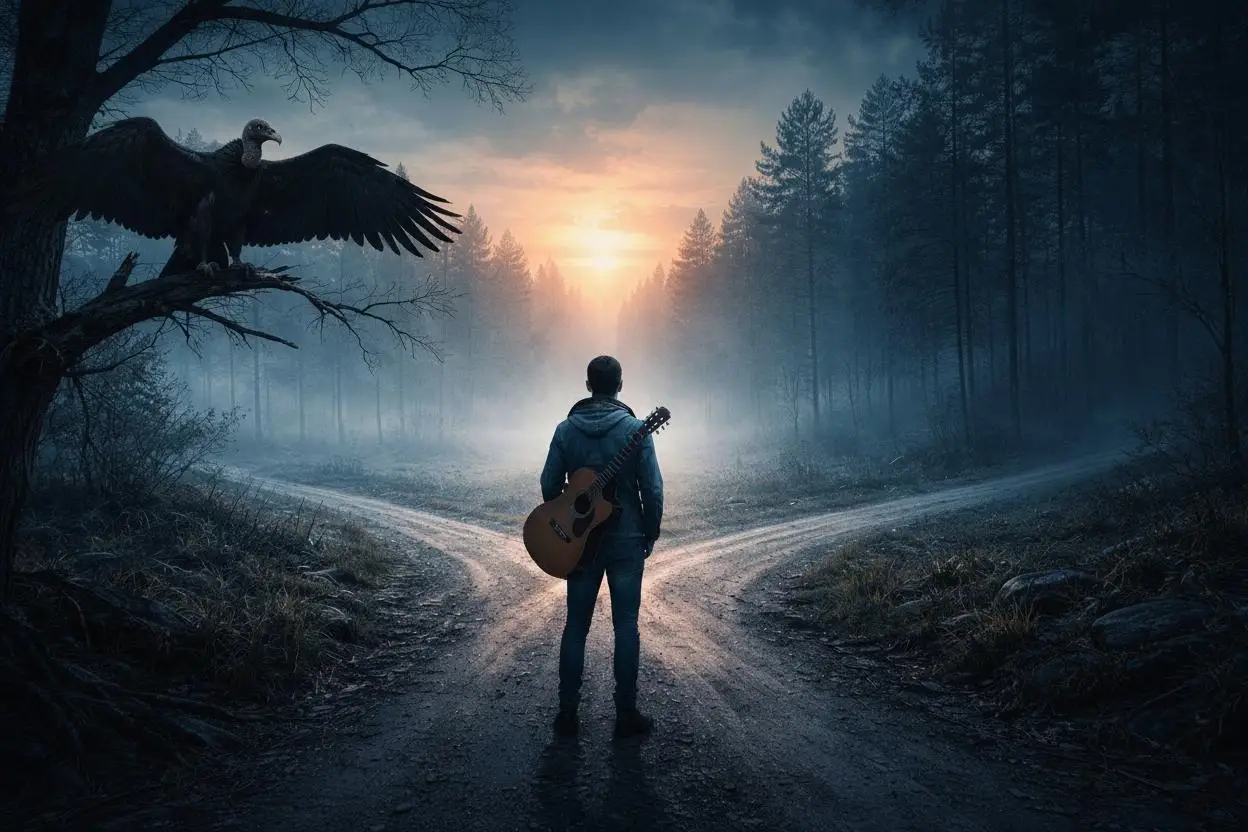
As we are in the prelude of 2026, the music industry stands at a crossroads more convoluted than ever before. Last year when I wrote my predictions for 2025 MusicTech, I wrote about blockchain, about NFTs, about Web3 etc., but for 2026 it feels almost irrelevant to talk about much beyond Artificial Intelligence. While previous disruptions—from the iPod to streaming—changed how we consumed music, generative AI is fundamentally altering who creates it and what “music creation” even means.
After a tumultuous 2025 marked by billion-dollar lawsuits, landmark settlements, and the first AI-powered artists signing major label deals, 2026 will be the year these abstract debates crystallize into concrete realities that reshape every note and node of the music ecosystem.
From Courtroom to Collaboration: The Licensing Saga
The most significant shift heading into 2026 is the music industry’s pivot from litigation to legitimization. Throughout 2025, the three major labels waged legal warfare against AI music platforms Suno and Udio, filing copyright infringement lawsuits seeking damages up to $500 million. By year’s end, these adversaries had become partners, as I predicted earlier in these blog pages.
Warner Music Group settled with both platforms, while Universal Music Group reached agreements with Udio. Most see this as a fundamental transformation in industry strategy, but I believe it’s just predictable business strategy. These settlements establish an opt-in licensing framework where artists control whether their work trains AI models, and platforms commit to launching new models in 2026 trained exclusively on licensed material.
This represents the first stepping stones of an infrastructure for a new music economy. The settlements raise critical questions that will define 2026: How will permission systems actually work at scale? What will compensation models look like for training data? Is there any upside for the artist? And, will ethically-sourced models match the quality of their predecessors trained on unlicensed material?
The licensing deals also signal something profound about power dynamics. Major labels are positioning themselves as gatekeepers to AI music’s legitimacy, potentially locking independent artists out of lucrative training deals unless they join the major label system. Meanwhile, Suno’s $250 million Series C round at a $2.45 billion valuation demonstrates that investors believe the licensed AI music market will be massive, and these platforms are racing to capture it.
The AI-Generated Content Earworm
Deezer reported that 50,000 fully AI-generated songs are uploaded to its platform daily, up from just 10,000 at the start of 2025. This exponential growth isn’t slowing, it’s accelerating as tools become more accessible and outputs more sophisticated.
In 2026, we’ll see this flood reach critical mass across all streaming platforms. The implications are staggering: traditional discovery mechanisms will strain under the weight of algorithmic output, playlist curation will require unprecedented sophistication to separate human from synthetic, and the sheer volume will force platforms to make hard choices about what content deserves prominence.
This creates a future with «two paths you can go by». On one path, platforms like iHeartRadio have pledged “Guaranteed Human” programs that exclude AI vocalists entirely. On the other, AI-created «artists» are signing major deals—the AI «artist» Xania Monet reportedly signed a multi-million dollar agreement with Hallwood, only to have the music pulled from iHeartRadio when the policy was announced. This fragmentation means 2026 will be defined by opposing visions of music’s future operating simultaneously.
Cosmic Slop
It should not come as a surprise that the leading entertainment conglomerates share a single-focused vision, profit. What is more disheartening, though, is how willingly we are risking obliteration of human creativity. Generative-AI solutions are basically just giant, «cosmic remixing machines». There is a «data Cosmos» that serves as an infinite repository of human creativity, and lyrics, voices, song structures etc. drawn from this universe will always be derivatives.
One could argue, with some merit, that this is not that different from how popular music has always been made; «remixing» influences into new sounds and new hits. However, if we make this repository and method the main source of music making, then we close the door to «real genius», I believe.
The Evolution of the AI Music Platform
The notion that AI music platforms are simply “press a button, get a song” tools is already «yesterday’s hit». Suno’s acquisition of WavTool, a browser-based digital audio workstation, and the launch of Suno Studio point toward AI platforms evolving into professional production tools rather than novelty song generators.
In 2026, AI platforms will increasingly offer stem generation, MIDI file exports, multitrack editing capabilities, and integration with traditional DAWs. Companies like Udio, Stability AI, and emerging players like Mozart AI are all developing professional-grade AI-powered workstations that give musicians granular control over AI-generated elements.
This evolution matters because it repositions AI from threat to tool. Rather than replacing musicians, these platforms aim to augment professional workflows, generating chord progressions, creating reference tracks, offering melodic variations, and handling tedious production tasks. Research indicates AI tools have reduced music production costs and turnaround times for media companies by up to 70%, making them indispensable for content creators under tight deadlines.
We live in a consumerist society where increased productivity is seen as a means to an end, and in a market where 120K new products (songs) are uploaded daily. The question arises, do we really need more content?
The Remix Revolution and Fan Engagement
Platforms including Spotify, Udio, and new entrant Klay (which has secured licensing agreements with all three major labels) are developing “walled garden” environments where fans can reimagine licensed songs.
Imagine selecting any track from a licensed catalog and instantly generating a jazz version, a lo-fi hip-hop remix, or an orchestral arrangement. Multiple platforms announced such capabilities in 2025, with launches expected throughout 2026.
This represents a fundamental shift in the relationship between artist and audience. Music transforms from fixed artifact to interactive canvas. In theory, fans become co-creators within carefully controlled boundaries that protect original artists while enabling creative expression.
The revenue models remain murky, how do artists get compensated when fans generate thousands of variations? Another key question is whether these tools will feel limited and sterile within their licensed constraints, or whether they’ll unlock genuine creativity. Early indications suggest the technology is there; user adoption will depend on whether the licensed environments feel expansive or restrictive.
The Copyright Time Bomb
While settlements grab headlines, the underlying copyright questions remain explosive and largely unresolved. The Anthropic settlement with composer Daryl Bartz for $1.5 billion represents the largest AI copyright settlement in history, signalling the potential damages at stake.
For 2026, the critical issue isn’t whether major labels and AI platforms can reach deals, they clearly can, with enough money changing hands. The existential questions affect everyone else: independent artists whose music was used for training without consent, content creators who used AI-generated music that might now face retroactive copyright claims, and the millions of songs already generated whose legal status remains ambiguous.
The U.S. Copyright Office has indicated that fully AI-generated music may not qualify for copyright protection, creating a bizarre scenario where AI music exists in a legal gray zone, potentially free for anyone to copy, but also potentially infringing on training data copyrights. This paradox will likely drive more litigation in 2026 before courts establish clear precedent.
Independent musicians face a particularly precarious position. Without the leverage of major labels, they may find their work included in training datasets with minimal compensation, while simultaneously being shut out of lucrative licensing deals that favor major label artists. This could accelerate the consolidation of power in the music industry, with AI reinforcing rather than disrupting traditional hierarchies.
What Does “Musician” Mean in 2026?
Discussing AI and music in these pages I return to Roland Barthes’ idea of «the death of the author». The French cultural critic Barthes envisioned an interpretation of art where the origin, author intentions etc. were irrelevant to the interpretation. With Gen-AI we’re at a stage where we virtually have «authorless» works on the market.
The philosophical implications may be more profound than the technological ones. If anyone can generate a complete song with a text prompt, what separates professionals from amateurs? Does technical mastery of instruments still matter when AI can generate flawless performances?
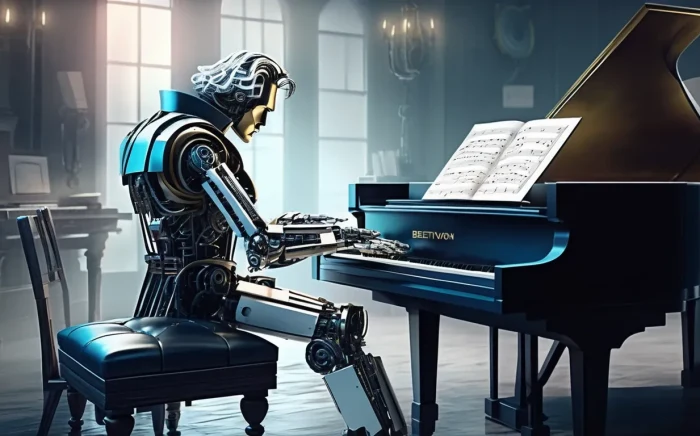
There’s an argument that AI won’t replace craft—it will amplify it, giving skilled musicians new tools for expression while making the human element more valuable precisely because it’s distinct from algorithmic generation. I’m less optimistic, I believe that the struggle is half the battle won. Although Ideas sometimes just float in «from the ether», the struggle to create is essential to create art that rings true and connects. All you need to do is have a look at one of Beethoven’s manuscripts and see all the fervent scribbles and rewrites!
Furthermore, the importance of flaws is easy to overlook. Imperfections and disharmonic personality traits and practices are often exactly why we love an artist. Autotune has been responsible for levelling out pitch imperfections since the late 1990s, but with AI the whole output is perfectly tuned and levelled with no exciting disharmony in the mix.
In 2026, we’ll likely see the emergence of a new category: AI-augmented musicians who blend human performance with AI generation. The positive spin is that using technology this way could realize creative visions impossible for either human or machine alone. The flipside is a reality where we drown in «AI-slop», just copy/paste sounds drawn from the giant, cosmic remix-machine.
The Industry Infrastructure Challenge
Beyond creation, 2026 will test music industry infrastructure in unprecedented ways. Metadata, always a messy problem, becomes critical when determining which artists deserve compensation for training contributions. Streaming platforms must develop sophisticated detection systems to identify and appropriately categorize AI-generated content. Rights organizations need new frameworks for tracking and paying micro-contributions to training datasets.
The sheer volume of AI-generated music will also stress discovery systems. When anyone can generate unlimited music, how do listeners find what matters? Algorithmic curation becomes even more important, but also more problematic—if the algorithms favor AI-generated content that’s optimized for engagement over human artistry, we risk a nasty feedback loop where AI drowns out human creativity.
AI could also revolutionize sync licensing, finally bringing scale and efficiency to what has remained a largely manual process. As content production accelerates and timelines compress, automated sync licensing powered by AI could become standard, dramatically lowering barriers for content creators while generating new revenue streams for artists.
The Democratization vs. Dilution Duet
The central tension of 2026 will be whether AI democratizes music creation or dilutes its value. Proponents argue that lowering technical barriers means more voices can be heard, and musical diversity will flourish. Critics counter that flooding the market with algorithmically-generated content will make it harder for human artists to break through, while simultaneously training audiences to accept lower-quality, derivative music.
We could see a bifurcated market emerge: premium, verified human music occupying a prestige tier with higher values and dedicated audiences, while AI-generated content dominates volume-driven applications like background music, social media content, and ambient listening. The middle, professional musicians making solid but not extraordinary music may face the most disruption.
The music market has historically always been divided and fractional, but along two main philosophies, those that see music as purely an entertainment product and those who view it as essential to life. However, this is not a binary segmentation, and you have levels of interest and levels of music buying budget as well, of course. What streaming did was effectively delete the premium/prestige market as people who bought more then 4-5 albums a month started paying $9.99 a month to stream music instead.
I have made the case for physical formats before, and we will likely see continued resurgence as a counterweight to AI abundance. Vinyl, cassettes, and even CDs represent tangible connections to human artistry in an increasingly digital and algorithmic reality. The tactile, intentional experience of physical media becomes more valuable precisely because it contrasts with endless algorithmic streams.
Rewinding to the advent of streaming, this was the watershed moment when music went from an abject of substantial cultural «mass» to being content like any other, easily obtained and rapidly mass-consumed.
Next Note: Speed & Velocity
As we move through 2026, the pace of change will only accelerate. New AI models trained on licensed data will launch, testing whether ethical sourcing can match performance. More artists will sign deals blending human and AI elements. Platforms will implement new detection and categorization systems. Courts will issue rulings that clarify copyright boundaries.
The music industry has survived previous disruptions by adapting, though as in the case with streaming, the industry had to adapt to a new paradigm that emerged beyond their control. And, AI is not just changing the business model but questioning fundamental assumptions about creativity, authorship, and what music even is. The transformation ahead isn’t simply technological; it’s cultural, legal, economic, and philosophical.
For musicians, 2026 will require strategic choices: embrace AI as a tool, resist it as a threat, or carve out a human-verified niche. For listeners, it will mean developing new literacy to distinguish algorithmic from authentic. For the industry, it will mean building entirely new infrastructure while the ground shifts beneath their feet.
One thing is certain: 2026 won’t represent the «Grand Finale» for AI challenges, but it will certainly be the year we stop debating whether AI will transform music and start living with the consequences of that transformation.
Well, we know where we’re goin’ But we don’t know where we’ve been. And we know what we’re knowin’ But we can’t say what we’ve seen. (Road to Nowhere – Talking Heads)