We are in the midst of a war over content. In my days as an SEO specialist, «Content is King» was the pre-eminent axiom. This due to the fact that content really drove the whole search-engine eco-system, and that volume and quality of content were deciding factors in success with Search Engine Optimization.
As Social Media and the whole influencer economy exploded, a new dimension, and complexity, emerged regarding content. «Content Creator» became a valid, and much coveted, job-description and identity builder. With a whole industry, to a certain degree, built around the content of others, there are legal ramifications regarding rights-owners, fair use etc.etc.
Generative AI is the last dimension accelerating content volume and complexity. It is a universe built on the supernovas, meteors, atoms and particles of millions of content creators. The sheer scale and the meteoric impact of Gen-AI which momentum is not too impeded by legal restrictions are shaking up the foundations of all content industries.
In addition to these three dimensions or stages in content employment, there are
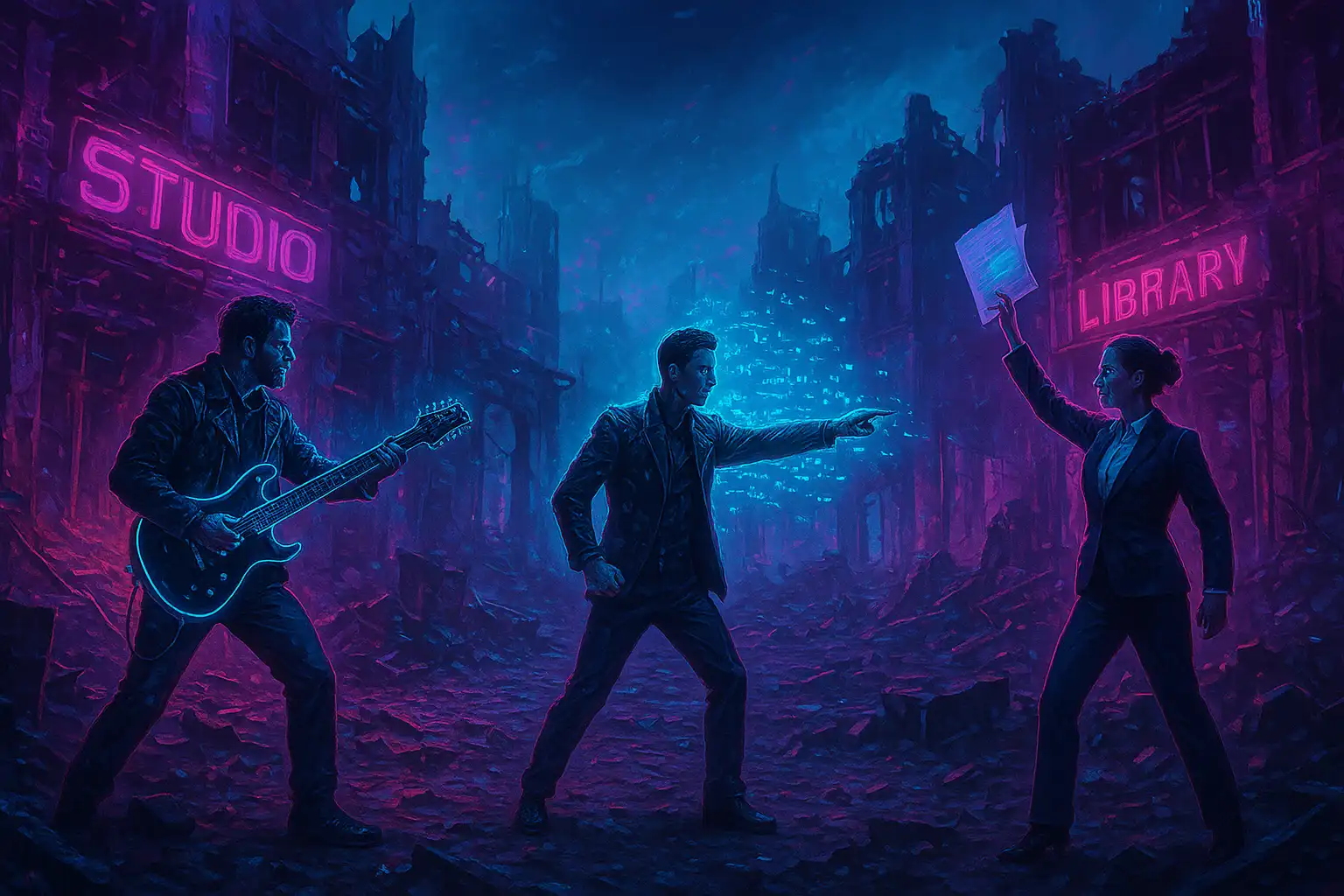
three primary forces in this fight: 1. generative AI companies seeking unfettered access to content for model training, 2. individual artists fighting for fair compensation and control over their work, and 3. entertainment conglomerates aggressively defending their intellectual property empires. The outcome of this conflict will fundamentally reshape how creativity is valued, distributed, and compensated.
Let’s examine the strategies, the visions, the loyalties and the contents of «the armoury» of the three «armies» that are central to the content wars.
The AI Industry: The Conqueror’s Vision
Generative AI companies have positioned themselves as pioneers of a creative revolution, arguing that broad access to existing content is essential for training models that will democratize artistic creation. Their vision rests on the premise that AI-generated content represents a new form of creativity that benefits society by making artistic tools accessible to everyone, regardless of traditional training or resources.
Companies like OpenAI, Anthropic, and others have trained their models on vast datasets scraped from the internet, including copyrighted material from books, articles, images, and music. They argue this practice falls under fair use doctrine, claiming their models transform original works into something fundamentally new rather than simply reproducing them. This position treats existing creative content as a commons—a shared resource that should fuel technological advancement for the «greater good.»
In addition to these «Megalodon» companies there are niche companies for music creation like SunoAI allowing users to create songs from prompts. The advent of these type of companies created a lot of controversy as these models are trained on copyrighted material, and SunoAI and Udio (same concept) were promptly suited by the major labels. These companies also have «deep pockets» and they operate with the old «move fast and break things» ethos most likely with a long-term strategy of cutting a deal with labels down the road.
The AI industry frames copyright restrictions as barriers to innovation, suggesting that overly protective intellectual property laws could stifle the development of tools that might unleash unprecedented creative potential. They point to the transformative nature of their technology, arguing that AI models learn patterns and styles rather than storing and reproducing specific works, much like human artists learn by studying existing art.
This approach to content acquisition most likely will not survive legal scrutiny. The fundamental question remains whether training AI on copyrighted material without permission constitutes fair use or systematic infringement at an unprecedented scale.
The Individual Artist: Between a rock and a hard place
For individual artists, the current landscape presents a perfect storm of economic pressures. They are fighting battles on multiple fronts: against AI companies that use their work without permission or compensation, against streaming platforms that pay fractional royalties, and against entertainment conglomerates that maintain tight control over distribution and monetization.
Artists argue that AI companies are essentially mining their life’s work to create competitors. A musician who spends years developing a distinctive style might find AI models trained on their songs generating similar-sounding tracks within seconds.
A landmark copyright case is relevant in this context. In 2013, the estate of Marvin Gaye sued songwriters Robin Thicke and Pharell Williams over their hit «Blurred Lines» and its reliance on Gaye style «groove» and «feel» from the song «Got to Give it Up». The estate won the case, and marked the first time songwriters were in breach of copyright based on stylistic features more than chord progression and melody.
As I see it, Gen-AI content is one giant «remix machine» where all the output is a scrambled version of the copyrighted input. When AI can generate content that mimics an artist’s style, it potentially devalues their entire body of work. Why invest in original music when an AI can produce something similar at minimal cost? This dynamic threatens to create a race to the bottom in creative pricing, where human-generated content must compete with machine-generated alternatives on pure cost rather than artistic merit.
Artists also lack the resources to fight these battles effectively. While major entertainment companies have legal teams dedicated to copyright enforcement, individual creators often cannot afford protracted legal disputes against well-funded tech companies. This power imbalance leaves many feeling helpless as their work is incorporated into systems that may eventually replace them.
The situation is becoming increasingly fuzzy by the fact that many artists rely on digital platforms for exposure and income. These same platforms increasingly integrate AI tools, creating a catch-22 where artists must participate in systems that undermine their long-term economic interests to maintain their current livelihood.
Entertainment Conglomerates: The Aggressive Guardians
Major entertainment companies like Universal Music Group (UMG), Sony, and Disney represent the third force in this struggle, wielding substantial legal and financial resources to protect their content libraries. However, their approach often appears indiscriminate, targeting not just AI companies but also educational content creators, reviewers, and fans who engage with their properties.
The case of Rick Beato, a music educator and YouTube creator, illustrates the aggressive stance many conglomerates have adopted. Despite creating content that should be considered educational fair use and potentially promotional for the artists involved, Beato faces constant copyright claims from UMG and other labels. In one particularly egregious example, a single 42-second video featuring just 10 seconds of an Olivia Rodrigo song resulted in copyright violation charges. Another video, an interview with producer Rick Rubin, generated thirteen separate copyright claims.
The major labels appear to be applying a zero-tolerance policy that treats educational commentary, criticism, and fan engagement as threats rather than as valuable ecosystem components that help maintain cultural relevance for their properties. I believe that this stems from a fundamental, historical dynamic of tension between control and promotion.
While aggressively protecting their content might generate short-term licensing revenue, it may also alienate the creators and communities that help keep their properties culturally relevant. Educational content creators like Beato often introduce younger audiences to older music, potentially driving new sales and streaming revenue. By shutting down such content, labels may be undermining their own long-term interests.
This approach also highlights the vast resource disparity in copyright enforcement. While entertainment companies can afford aggressive litigation strategies, individual creators and educators often cannot fight back effectively, creating an asymmetric enforcement situation where corporate interests consistently prevail over creative or educational expression.
The Great Remix: Culture, Innovation and Entertainment Economy
The outcome of this «Mexican standoff» will determine far more than just who profits from creative content. At stake is the fundamental nature of how culture evolves, how innovation proceeds, and how creative work is valued in society.
If AI companies succeed in establishing unrestricted access to existing content, we may see an explosion of AI-generated material that democratizes certain forms of creativity while potentially flooding the market with low-cost alternatives to human-created work. This could lead to a bifurcated creative economy where high-end, clearly human-generated content commands premium prices while AI-generated material dominates mass markets.
And, let’s be real «mass produced» music didn’t kick-off with Gen-AI, generic music for mass-consumption made by human hands has been around since recorded music; the more generic, the easier replaceable by AI. It’s harder to imagine, say AI being used to «replace» and artist like, say, Tom Waits.
If the major companies maintain strict control over their content libraries while pursuing aggressive enforcement policies, we’ll see a cultural environment where commentary, education, and creative reuse become economically prohibitive for all but the largest players. This could stifle cultural dialogue and limit the ways audiences can engage with and build upon existing works.
New frameworks need to distinguish between commercial AI training, educational use, and transformative creativity while ensuring that original creators receive fair compensation when their work contributes to new commercial products.
Next: A Positive Feedback Loop or Capital Cacophony?
The battle for creative content reflects deeper questions about power, ownership, and value in the digital age. Rather than allowing market forces alone to determine the outcome, society must actively shape policies that balance innovation with creator rights, cultural access with economic justice.
Potential solutions might include mandatory licensing schemes for AI training data, expanded fair use protections for educational content, and revenue-sharing models that ensure original creators benefit when their work contributes to AI-generated content. The goal should be creating a positive feedback loop where technological innovation, individual creativity, and cultural engagement can mutually reinforce each other.
There is only one way to «win the content wars», and this is by accepting that nether rigid control nor a «free content-buffet» are sustainable options. Gen-AI brings a lot of exciting possibilities to work creatively, but also the hazard of a wipe-out of creative industries if not handled with care. The choices we make today about content ownership, usage rights, and creator compensation will determine the conditions for cultural creation for generations to come.