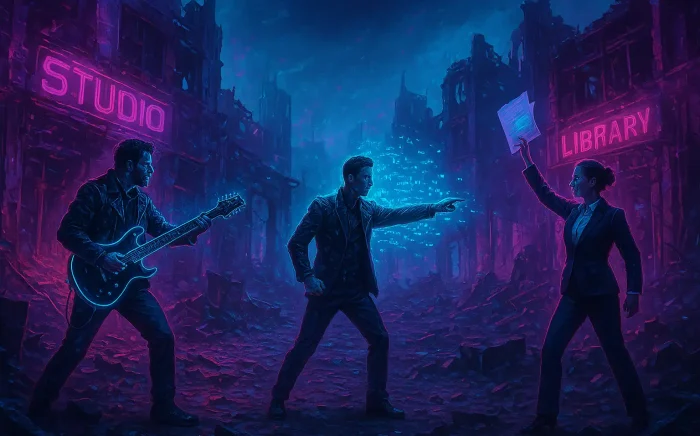
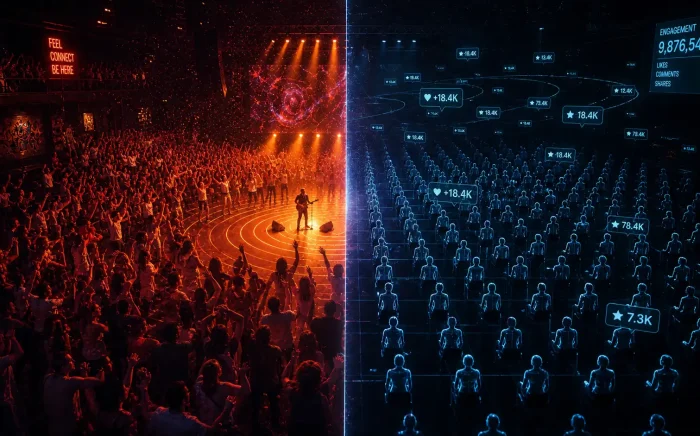
There’s a track doing the rounds online. It sounds like a lost Radiohead B-side, that specific cocktail of melancholy arpeggios, «Thom Yorke» falsetto, and a bass line that feels like it’s slowly creeping up on you. People are sharing it. People are moved by it. And nobody made it. Not in the way we used to mean “made.” Welcome to the simulacrum. Population: everyone
Baudrillard Walks Into a Recording Studio
Jean Baudrillard, the French philosopher who spent much of the late twentieth century being gleefully provocative about reality, gave us one of the more useful and unsettling conceptual tools for thinking about the current AI moment. His idea of the simulacrum isn’t simply a copy or a fake. It’s deeper than that. A simulacrum is a copy without an original. A representation that has long since eaten the thing it was supposed to represent.
Baudrillard described this evolution through four stages. First, an image reflects a basic reality (a photo of a real place). Then it masks and distorts that reality (propaganda, advertising). Then it masks the absence of reality (the image pretends there’s something behind it when there isn’t). Finally, the image becomes pure simulacrum bearing no relation to any reality whatsoever. It simply is.
AI-generated music is arguably already at stage four.
When Suno or Udio or any of the proliferating tools generate a “blues track,” they are not referencing the Mississippi Delta, the specific misery of crop debt, or the acoustic physics of a guitar strung with whatever you could find. They are referencing the accumulated sign of all those things; the data ghost, the spectral average of blues-ness as extracted from millions of recordings. The original has not just been copied; it has been dissolved. What remains is the pure, weightless form.
And here’s Baudrillard’s genuinely dizzying trick: this doesn’t make it less real to us. If anything, it makes it more real. The AI blues track is more blue than blue, because it is blues freed from the inconvenience of having to mean anything specific.
A Threnody for the Aura
Walter Benjamin was worried about something adjacent sixty years earlier. In his landmark 1935 essay “The Work of Art in the Age of Mechanical Reproduction,” he identified what was lost when a painting could be photographed and distributed to millions: the aura. This quality of presence, of singular existence in a particular place and time. A print of the Mona Lisa has no aura. The Mona Lisa, frustratingly small and behind glass in the Louvre, has it in spades.
Benjamin was not entirely pessimistic about this. He thought the destruction of aura might have democratic potential; art freed from its ritual, cultic context could become political, could reach people. This argument is related to what the Gen-AI companies love to make, “Art for everyone”. But Nemjamin was clear that something was being lost even as something was being gained.
What would be Benjamin’s take on AI music? He’d possibly see it as the logical terminus of his own argument. Mechanical reproduction removed the aura of the singular original. AI generation skips the original entirely. There is no master tape. There is no moment of inspiration in a stuffy room at 2 am. There is no perspiration, no second-guessing, no two-hour argument about whether the snare is too high in the mix.
And so the question isn’t just whether the aura survives. It’s whether the concept of aura has any cache left at all. Benjamin imagined the copy haunting the original. Baudrillard says the copy killed the original years ago and has been impersonating it ever since. AI music is perhaps the moment we stop being able to tell the difference, or stop caring enough to look, or listen rather.
Enter the Materialists, Stage Left
At this stage, Mexican theorist Manuel De Landa would want to pull the discussion back to earth.
De Landa, working in the tradition of Deleuze and Guattari (D/G) but with a more hard-nosed, almost geological sensibility, argues that we shouldn’t get too lost in the play of signs and representations. Matter, process, and real physical causality still structure the world, even when we can’t see them.
His concept of assemblages (from D/G); collections of heterogeneous elements (human, non-human, linguistic, material) that coalesce into temporary, functional wholes, represents a more grounded way of thinking about where AI music actually originates.
An AI music system is an assemblage. It is server farms burning enormous quantities of energy in data centres. It is the labour of millions of musicians whose work was scraped without compensation. It is venture capital flows, copyright law, and the specific affordances of transformer architecture. It is you, sitting there, typing “lo-fi chill beats with a melancholy vibe” into a search box.
None of that is immaterial. None of that disappears into the pure play of signs. De Landa would insist that even the most abstracted simulacrum sits on top of is generated by real processes with real costs and real beneficiaries. The sign floats; the server farm doesn’t.
This is a useful corrective to both Benjamin and Baudrillard, who were both, in their ways, analysts of representation. De Landa reminds us that behind every representation there is a material history. The question of who captures value from the AI music boom is not a question about signs; it’s a question about power and resources, as unglamorous as that sounds.
How do we define AI Music?
Let’s try to hold all three lenses at once, because the picture gets interesting when you do.
Baudrillard would say AI music is the perfected simulacrum: genre freed from origin, emotion without biography, authenticity as pure aesthetic category. It’s not fake blues. It’s blues-as-concept, generated with such fidelity to the sign that the question of origin becomes irrelevant. Which is, of course, terrifying for us lovers of music.
Benjamin would perhaps say we are witnessing the final evaporation of aura, not just the aura of the individual work, but the aura of human creative agency itself. Or maybe, more charitably, he’d say we’re watching aura migrate. Perhaps it resettles on the prompt, on the act of curation, on the human choices about what to generate and how to use it. The DJ long ago made an art form out of selecting and arranging. Maybe the AI music prompter is the next iteration. Everyone’s «a selecta».
De Landa would say: fine, fascinating, but don’t forget the musicians whose livelihoods are currently being reorganized around them, the intellectual property regimes being stress-tested in real time, and the fact that training a large audio model has a carbon footprint that would give a Thom Yorke actual, not simulated, cause for gloom.
All three perspectives feel necessary. The purely philosophical analysis, Baudrillard’s brilliant, vertiginous account of signs eating reality, captures something real about the phenomenology of listening to AI music, the way it can feel uncanny and yet completely satisfying. Benjamin’s framework asks what is lost even in gains that feel progressive. And De Landa’s materialist lens is focused on who benefits, who pays, and what is built on what.
What if the Ghosts Move You?
Here is the question that tends to short-circuit the conversation: but what if it sounds amazing?
The AI music generators are (un)naturally becoming increasingly sophisticated. It is harder and harder to identify the unrealness of the songs. The Radiohead-adjacent track at the start of this piece, if you heard it without context, you might feel something. You might feel that something that music is supposed to make you feel.
Does the absence of a human author at the origin point negate that response? Baudrillard, I suspect, would say that question is already obsolete. The response is real. The feeling is real. The mechanism that produced it is, in his framing, no more or less artificial than the mechanism of genre convention, of studied influence, of a musician consciously copying their heroes.
Benjamin might say the feeling is real but diminished, and that there’s a difference between being moved by something made at cost and being moved by something generated at scale, even if you can’t feel it in the moment.
De Landa, probably, would just want you to listen to some actual old blues records and think about the full, material, historical chain that produced them. Not to condemn the new, but to be honest about what the new is built on.
The simulacrum surrounds us. It’s generating playlists. It’s learning your taste. It sounds, increasingly, like everything you’ve ever loved, because it was fed everything you’ve ever loved, along with everything everyone else has ever loved, in a process that may be the most consequential act of cultural ingestion in human history.
Whether that’s a wonder or a sort of quiet catastrophe depends on where you’re sitting. If you’re making music for a living, you already know the answer. If you’re making a playlist for a dinner party, you might not even bother with the question.
We should, though.