
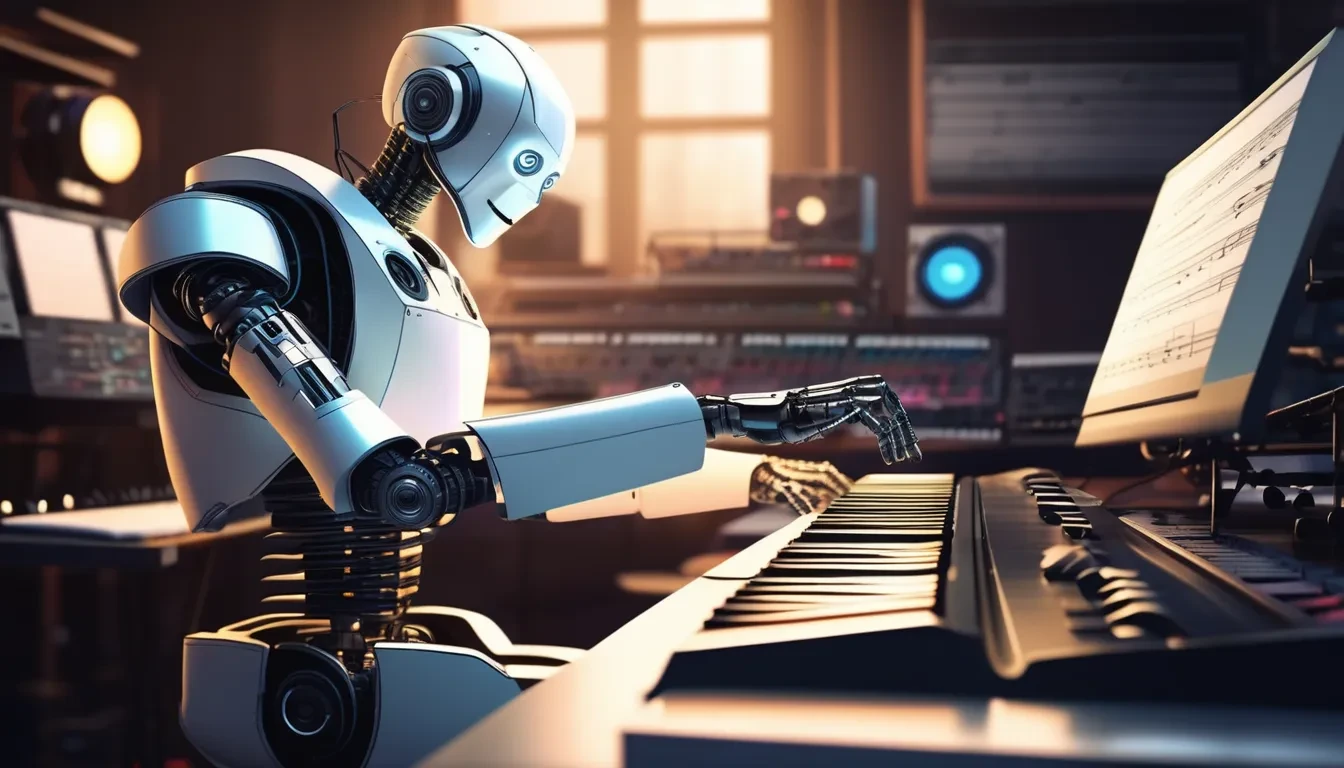
Unless you have lived under a rock with no WiFi connection and cell phone coverage, you are aware of the impact AI is having on the music business. With all the noise generated from generative AI, there’s been a lower volume setting regarding other aspects of AI-guided music production.
You’ll find that AI pops up its jagged, algorithmic head in all corners of music production already. And, as generative AI for music is mired in lawsuits and controversy, AI injects itself in all stages of music production, from songwriting to production and distribution.
AI-Tools for Songwriting
Amper Music is one «AI music composer» that creates «blocks» of music for «original compositions». Unlike Suno and Udio (the AI music generators facing lawsuits from the industry), Amper Music focuses on providing tools for users to create original music. Apparently, it doesn’t generate complete songs based on training Machine Learning models on existing copyrighted material. Instead, it offers building blocks and customization options, giving users more control over the composition process. This approach might reduce the risk of direct copyright infringement, but not erase it.
AIVA is another example, defined as an «electronic composer recognized by SACEM»: The latter referring to the French organization, The Society of Authors, Composers and Publishers of Music. By reading a large collection of existing works of classical music AIVA is capable of detecting patterns in music and «compose» new pieces.
AIVA primarily focuses on composing original music, particularly for applications like advertising, film scores, and video games. It doesn’t aim to replicate existing songs or artists, which reduces the likelihood of direct copyright infringement claims. As with Amper, users can customize the generated music extensively. This emphasizes the user’s creative input and further distances the output from potential copyright issues
Stuck on writing lyrics? Naturally, there’s an AI solution. Tools like MasterWriter, Claude, and numerous more offer AI-automated lyrics for the writer who is experiencing having been abandoned by his/her muse. As a dedicated literature nerd, it is not a type of tool I’m likely to test, but surely the results can’t be worse than the majority of the lyrics of today’s most popular hits.
eMastering with AI
Once you have birthed your AI-assisted «baby», it needs to be groomed for the outside world. In other words, mastered. Tools like LANDR and LALAL.AI are using AI for mastering, separating vocals from instrumentals, and even generating song ideas. Using eMastering services is a relatively low-cost way to get your track ready for streaming platforms (if not exactly for vinyl).
These are just a few examples of how the whole creative process for creating music can be largely left in the cold yet powerful hands of your AI assistants. The question is, what are the effects of this less organic, more artificial way of creating music?
The Death of the Author
French literary critic Roland Barthes introduced his claim-to-fame-idea in his 1967 essay “The Death of the Author.» Once a work is published, it’s detached from the author. The reader brings their own experiences, biases, and understanding to create meaning. In a sense, the reader «writes the work», through interpretation.
If we translate Barthes’s idea to music, we must add more dimensions. It’s no longer the reader or listener, alone who «kills» the author/composer, but technology. When a substantial part of the creative process is left to technology, what is left of the «author»?
Honing your artistic skills through intense study and practice is not only to achieve a level of ability but it is also essential in forming your artistic identity. If creatives are allowed to leapfrog this whole process, we detach creative potential from the process to fully realize said potential. In other words, artists are sidetracked from reaching their full potential. However, if you want to spin this paradigm in a more positive direction; it also democratizes artistic creation.
Meng Ru Kuok, the CEO of Bandlab, a music-making app with more than 100M users, claims that: ‘there will be over 1 billion music creators by 2030, potentially even sooner.»
He refers to «music creators» here, and the question is how do artistic identities and roles mutate in this algorithmic reality and how does it affect rights management, in particular?
The Composer as Curator
We have previously talked about how sounds and songs have been deterritorialized into content, and we probably need to talk about another identity shift, from «composer» to «curator» (of sounds).
We can also talk about the death of the songwriter in this context. On average, a pop hit today will have 5-10 credited «songwriters». Someone gets credit for a beat, some for another loop, some for the top-line melody etc. etc. Gone are the days of the David Bowie’s of the world, the lone songwriting genius bestowing his creations upon the world.
In Jamaica, they historically refer to a DJ, as a selecta, that is, someone who selects the tracks to play. In this new paradigm, composers become «selectas», or curators of sound. Beats, chord progressions, and lyrics are generated with a few clicks instead of painstaking work and desperate searches for the Muse.
This new praxis will undoubtedly have ramifications for handling the ownership of works created in this network of humans and algorithms. Recently, there was an interesting case of Jason M. Allen who submitted an AI-generated “painting” to a Colorado digital art competition and won.
Now, he complains he is being «ripped off» by people copying «his work». The U.S. Copyright Office has ruled that work derived from AI platforms “contained no human authorship” and therefore could not be extended copyright protections. Mr.Allen shouldn’t hold his breath regarding receiving income from ownership of his, essentially, prompting on Midjourney. However, the case raises an interesting issue regarding ownership.
Digital Rights Management (DRM) – What’s Next?
This fragmented «micro-ownership» that is already the norm in the world of pop music, will inevitably become even more complex and fragmented, with AI added into the mix.
New licensing models that cover the use of AI in music creation are needed. This could involve licensing the AI model itself, licensing the training data used to create the model, or licensing the output generated by the AI.
DRM could also be processed in real-time for usage-based licensing where the licensing fee changes based on how often it’s played. Real-time DRM could track plays and adjust the fee accordingly, benefiting both artists and rights holders. Content could be restricted to certain geographical locations. For example, a live concert stream might only be accessible to viewers in specific countries
This could also lead to dynamic pricing, like in transportation, where demand, time, and location are factors affecting pricing. More agreeable, perhaps, is the potential for more personalized content. Furthermore, a real-time solution where a song is connected to a DRM server would also reduce the potential for fraud and copyright infringement.
Now, is probably the time for a Blockchain-based system for records of ownership. This is a solution that has been in the wings for quite some time. Blockchain’s fundamental principle of immutable transfer of information can be a foundation for the mechanism of ownership and monetary distribution.
Instead of relying on a central server, the digital asset and its associated metadata could be stored on a decentralized network of computers. This makes the system more resilient to hacking and censorship. Blockchain can facilitate peer-to-peer content distribution, reducing reliance on intermediaries and potentially lowering costs.
Blocks on the chain are assigned a so-called hash – a unique digital fingerprint on a data set. Each digital asset (song, video, image, etc.) would be assigned one and registered on the blockchain. This creates an immutable record of ownership and provenance. Important metadata about the asset, such as the creator, copyright holder, licensing terms, and usage history, would be stored alongside the identifier on the blockchain.
Smart contracts, a line of code that automates actions like payments when certain conditions are met, define and enforce the rules for accessing and use of the digital asset in this environment. Every transaction and interaction with the digital asset can be recorded on the blockchain, creating a permanent and auditable history. This increases transparency and accountability.
OUTRO
As always when there is rapid technical innovation in a section of society, legislation and structural reforms lag behind.
Accurately defining what the new AI-assisted landscape will look like regarding creative expression and market infrastructure is like nailing the key-signature of the average Tool song on the first listen!
What we do know for certain is that we are in the very early intro of a «symphony of change» that will revolutionize the music industry, at every level!


Fascinating article! Very educational.
Thank you for your comment, Victor!